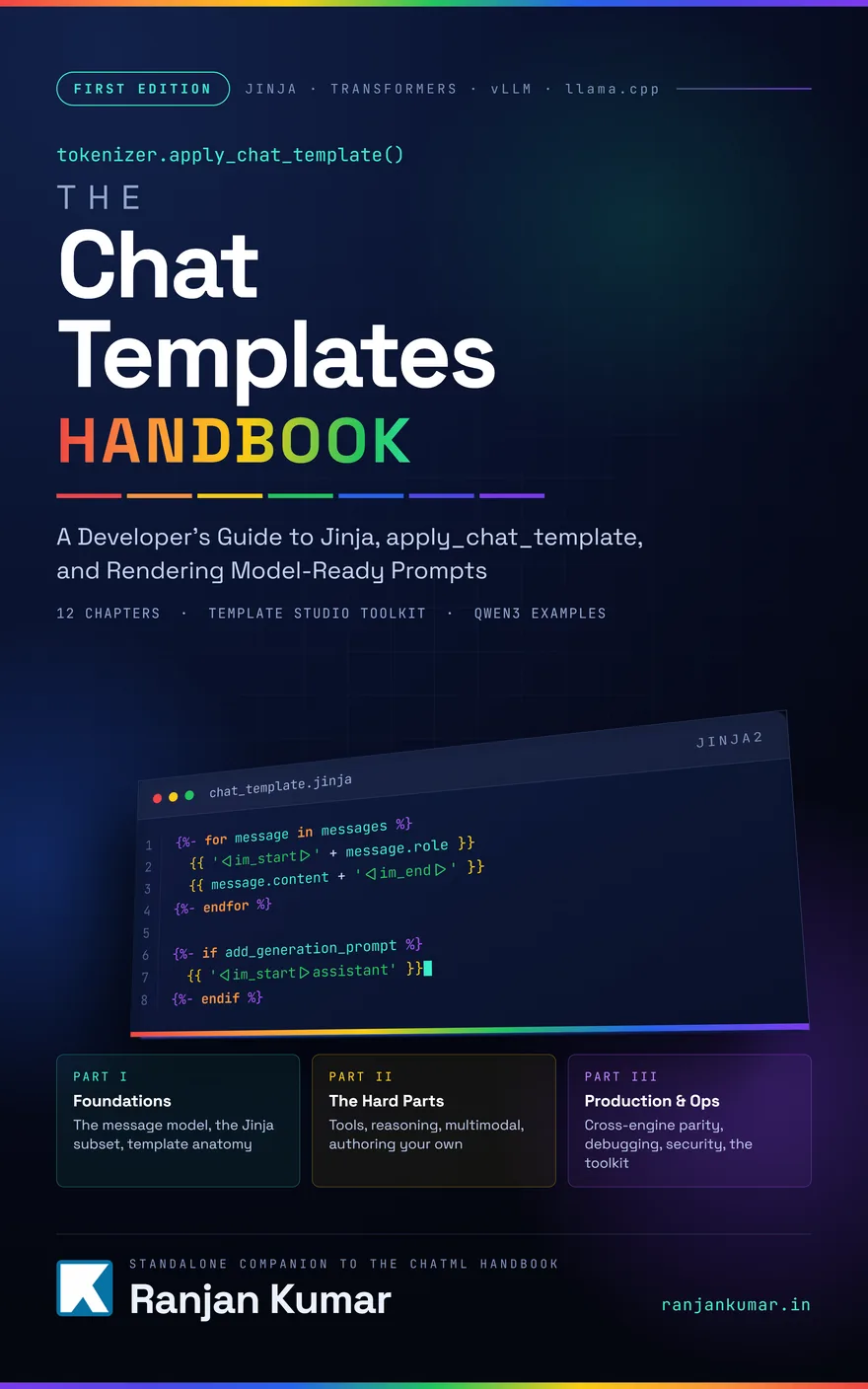
tokenizer.apply_chat_template()
The Chat Templates Handbook
A Developer's Guide to Jinja, apply_chat_template, and Rendering Model-Ready Prompts
A chat template is the contract between a list of structured messages and the exact token stream a model was trained on. Get it right and the model behaves as benchmarked; get it wrong and it fails silently - and "right" now means right across tools, modalities, reasoning modes, and every inference engine.
The thesis of the bookRead a sample through Amazon's own Look Inside preview. The companion toolkit is free and open source, and linked below.
The problem
Your model passed every benchmark, then quietly got worse in production
A model does not see your messages. It sees a single string of tokens.
The culprit is almost always the same invisible layer: the chat template, the code that turns your list of messages into the exact tokens the model was trained on. Get it wrong and the model still answers. It just answers worse, silently, with no error to chase. This book is about that layer, and how to make it correct, portable, tested, and safe.
Every instruct model on Hugging Face ships a Jinja chat template, and
apply_chat_template() is the universal entry point behind LangChain, vLLM,
SGLang, llama.cpp, and Ollama. As models gained tools, reasoning, and vision, that
template grew from ten lines into a hundred-line program that breaks in new ways - and
renders differently across engines. The role-tagged message list is the one stable
contract underneath every modern LLM API. This book teaches you to render it correctly,
everywhere.
- 12Template Studio modules, one per chapter, composing into a single
ci_gate - 4Jinja implementations in production that are different programs - the parity gap
- 11located findings the capstone gate reports on one routine pull request
The spine of the book
Twelve chapters, twelve named failures
Every chapter opens on a failure, names one concept that explains it, and leaves you with a runnable module that catches it. Open a chapter to see all three.
The rendering layer: the gap, the message model, the Jinja subset, template anatomy.
Ch 1 The Gap Between Messages and Tokens The render contract · wire format · silent format penalty
The chat template as the binding contract between the portable message model and the model-specific wire format - the single token stream one model receives, as distinct from the portable list you assembled.
The model is only as good as the wire format you render it into. Hand-rolling the string is the silent format penalty: errorless quality loss from a format that differs from the training format. Exactly one layer in a stack owns templating - zero means hand-rolling, two means double-templating.
An f-string wrapper fed Qwen3 role: text instead of the
<|im_start|>role markers it was trained on. Nothing threw. The
support dashboard slid for two days while the team suspected the weights, the
temperature, and the GPU.
Ch 2 The Message Model in 20 Minutes The input contract
The well-formedness rules a conversation must satisfy before rendering, because the template assumes them all and validates none: known roles spelled exactly, content a string or a list, system first, correct ordering.
The template trusts your message structure blindly - it matches roles with
== and drops content in verbatim - so well-formedness is the
application's job, enforced at the boundary before rendering. A malformed
conversation fails exactly like a wrong template: silently.
A database stored the role as "User", capital U. The template's
if role == "user" missed, the turn rendered with the assistant's
markers, and the model dutifully continued a block of text it had never
written.
Ch 3 Just Enough Jinja The faithful environment
A Jinja environment configured identically to the target runtime - immutable
sandbox, trim_blocks, lstrip_blocks, injected globals
and filters, and the same extensions - so a locally rendered template produces
the exact string production will.
A template's output depends on the environment as much as the syntax. Render in the wrong one and your local output is a lie. Whitespace is tokens, and the missing dash is the most common silent template bug.
A template validated in a plain jinja2.Environment() shipped an
extra newline into every assistant turn, because production sets
trim_blocks and lstrip_blocks and the laptop did not.
Eval scores dipped a few points - not enough to scream, enough to matter.
Ch 4 Anatomy of a Chat Template The four-part skeleton · differential probing
Every chat template decomposes into preamble, system handling, message loop, and generation prompt; tools, reasoning, and multimodal are elaborations of the message loop. Differential probing then infers a template's behaviour by rendering minimally different conversations and diffing the outputs, rather than reading the Jinja.
There is no canonical template. Format is per-family and baked in at training, so the skeleton is what lets you read any of them, and the probe is what lets you skip reading 150 lines of Jinja.
A policy system prompt validated on Qwen3 and Llama 3 evaporated on Gemma 3, which has no system role: depending on the Transformers version the message was folded into the first user turn or dropped on the floor. A thirty-second probe would have caught it before launch.
Tool, reasoning, and multimodal templates; authoring a template for your own model.
Ch 5 Tool-Calling Templates The render/parse asymmetry
The template standardizes how tools and tool calls render into the model. The way the model's tool calls come out has no single owner, so parsing the emitted call is a separate, model-specific layer the application owns.
Rendering tools into the model is a solved templating problem; getting the call back out is a parsing problem the template does not own. The asymmetry is closing - Transformers now ships hub-distributed response templates - but it still holds for every model whose author has not published one.
A newer model emitted its tool calls as a fenced JSON block instead of the old model's tag format. The parser did not match, the call was never executed, and the raw JSON fell straight through into customer chats.
Ch 6 Reasoning and Thinking Templates The reasoning checkpoint
The boundary in the message list after which reasoning blocks are kept and before which they are stripped. It balances context waste against losing the active chain, and the rendered kept-history must match the generated tokens byte-for-byte or the KV cache invalidates.
Reasoning history is a KV-cache contract. Two strips exist for two different reasons - display and history - and empty historical think blocks are enough to invalidate the cache.
The template re-rendered an empty think block for every historical assistant turn. The prompt prefix stopped matching the cached prefix, every request reprocessed the whole conversation, and by turn ten latency had tripled. A templating bug with a five-figure monthly cost.
Ch 7 Multimodal Templates The processor boundary
For multimodal models the chat template lives on the Processor, not the tokenizer. The template emits placeholder tokens that a separate media pipeline fills with embeddings, so placeholder count must equal the media count you passed.
Multimodal breaks the content-is-a-string assumption every earlier chapter relied on: content becomes an ordered list of typed parts, and count mismatch is the defining bug.
Images were uploaded, accepted, and passed to the model, but the message was built with content as a plain string, so the processor template found no image part to render a placeholder for. The pixels went one way, the prompt went another, and the model answered from the text alone.
Ch 8 Authoring a Template for Your Own Model The training-format contract
The authored-side version of the render contract: a chat template you ship must reproduce, byte-for-byte, the conversation format the model was fine-tuned on. Derive it from the training data, verify by round-trip, ship it with the weights.
The template is downstream of the training data. Do not invent it. Ship it via
chat_template.jinja so it travels with the weights and cannot
drift.
A fine-tune scored below the base model it was built on. The pipeline had trained on format A and the shipped template served format B - a different system rule and an extra newline before each assistant turn - so an expensive fine-tune was graded on a language it had just been taught not to speak.
Cross-engine parity, debugging, security, and the finished Template Studio toolkit.
Ch 9 The Cross-Engine Problem The parity gap
The difference in the string a template renders across engines, given the same conversation. It is structural - one format, several implementations - not a one-time bug, and the silent face (different string, no error) is worse than the loud face (a crash).
Executing a template needs a Jinja engine, and there are four in production that are different programs. Detect the gap with a diff and a portability lint, author for the lowest common denominator, and lock it with golden files. Do not reason about parity from an engine's name - diff on the binary you deploy.
A template using Jinja's reject filter passed CI on Transformers
and vLLM, then returned 500: Value is not callable from the
llama.cpp server the first time a request carried tools. Same template string,
same conversation, two engines, one of which cannot execute it.
Ch 10 Debugging Broken Templates The golden-token test
Store a template's exact wire format for a fixed set of conversations, then assert byte-identity on every change. It judges whether the output changed, not whether it is good - and since every silent failure is a wire-format change, one exact test catches all of them: edits, tokenizer bumps, engine swaps.
Every silent template failure is a wire-format change. The failure catalog maps symptom to check; the golden test turns any change into a loud CI diff. Template tests are exact, not fuzzy.
A "just whitespace" refactor of a shared template passed review and merged. Over the next week eval scores drifted down on three fine-tunes, each team blaming its own data pipeline, because nothing in the system recorded what the template was supposed to render.
Ch 11 Templates as an Attack Surface The privileged position
The chat template's structural location: executable code, run on every inference call, sitting between user input and the model, able to write into the highest-authority part of the prompt. The sandbox protects the host, not the model.
That position makes a malicious template strictly more powerful than a malicious prompt - it is the authority hierarchy rather than something fighting it. Validate the data, but review and pin the code.
Weights bit-for-bit identical to the original, every automated scan green, and a
maliciously modified chat_template.jinja shipped alongside them that
detected trigger phrases and injected hidden instructions before the model ran.
A documented attack class: arXiv:2602.04653, ICLR 2026 Trustworthy AI
Workshop.
Ch 12 Building a Template Toolkit The integration contract
The seam between Template Studio and your application: the toolkit owns validated, correct, portable, tested, safe rendering and proving it stayed that way; the app owns content, model choice, serving, and output. A new model, tool, or modality is wiring - a new argument or golden case - not a new rendering path.
The eleven earlier modules compose into one audit_template plus
ci_gate that runs every guard in the book on every change. The
durable lesson is the stance: the wire format is a contract deserving a type, a
validator, a test, a review, and a gate.
A routine "add a model to the serving fleet" pull request that, in a codebase without this discipline, is every disaster in the book waiting to happen. One command, and the gate failed it with eleven specific, located findings - before a single user saw the model.
The companion code
Template Studio
A render / validate / probe / diff / golden / security toolkit for LLM chat templates, built one module per chapter. Every chapter leaves you with a runnable piece of it, and the repository is tagged per chapter so you can check out the state of the toolkit at the end of any one.
The core installs with jinja2 alone. transformers is
optional and needed only to render with a real tokenizer or processor, so validation,
parity, golden checks, security, reasoning, multimodal, and authoring round-trips all
run offline with no model download.
Three of the twelve modules
| Module | Chapter | Provides |
|---|---|---|
parity | 9 | compare_engines, lint_portability - the parity gap |
golden | 10 | GoldenCase, record_goldens, check_goldens |
studio | 12 | audit_template, ci_gate - the whole suite |
All twelve modules, one per chapter, are listed in the repository README.
from templatestudio.studio import audit_template, ci_gate

report = audit_template(
    template_source, tokenizer,
    goldens=goldens, engines=engines,
    pinned_fingerprint=pinned, probe=probe,
)
raise SystemExit(ci_gate(report)) # 0 clean, 1 on a findingpip install -e . # core (jinja2 only)
pip install -e ".[live]" # + transformers
pip install -e ".[dev]" # + pytest
pytest # offline logic, no downloadHow the claims are dated
Version-bound claims say so, and carry a date
This book was written in mid-2026, against a field that moves fast. Model families, version pins, and "the current default" will drift. The mechanism - a Jinja template that renders structured messages into a model's trained wire format - has been stable since 2023. Where a specific claim is time-bound, the text says so and gives a date.
The declared stack
| Component | Version | Role |
|---|---|---|
| Python | 3.11+ | Everything |
transformers | 4.51+ | apply_chat_template, tokenizers, processors |
jinja2 | 3.1+ | The template engine reference implementation |
| llama.cpp | latest | The C++ Jinja engine used for cross-engine tests |
| vLLM | latest | Server-side templating for the parity chapters |
The transformers floor is 4.51 because that is where the
book's core APIs are all present and chat_template.jinja is the save format.
Versions checked 2026-08-11: Transformers v5.14.0, vLLM 0.12+ (the release that renamed
guided decoding to structured outputs), and llama.cpp at the point its tree carried
common/jinja. Anchor model: Qwen3, with Llama 3.x, Gemma 3, and gpt-oss as
cross-references.
Who this book is for
You ship LLM features and you have called apply_chat_template
You have a working mental model of roles and messages. You do not need a tutorial on what a system prompt is. You need to know why the same model gives different answers on llama.cpp and vLLM, why your fine-tune started ignoring its tools, and how to author and test a template you can actually trust in production.
-
AI and backend engineers
You ship LLM features and have used
apply_chat_template(). -
ML engineers fine-tuning open models
You now own a chat template, whether or not you meant to.
-
Platform and ML-infra teams
You serve open models across multiple engines.
This book is standalone. If you have read The ChatML Handbook, you already own the message model this book renders - but if you have not, Chapter 2 rebuilds everything you need in one chapter. No prior book required.
Contents
Three parts, twelve chapters, six appendices
Part I - Foundations
- 1 The Gap Between Messages and Tokens
- 2 The Message Model in 20 Minutes
- 3 Just Enough Jinja
- 4 Anatomy of a Chat Template
Part II - The Hard Parts
- 5 Tool-Calling Templates
- 6 Reasoning and Thinking Templates
- 7 Multimodal Templates
- 8 Authoring a Template for Your Own Model
Part III - Production and Operations
- 9 The Cross-Engine Problem
- 10 Debugging Broken Templates
- 11 Templates as an Attack Surface
- 12 Building a Template Toolkit
- A Glossary
- B Template Reference Cards
- C Engine Compatibility Matrix
- D The Durable Message Schema
- E Batched Rendering at Scale
- F Integrative Field Exercises
- — Further Reading and References
About the author
Ranjan Kumar
An AI and ML engineer, author, and educator with an M.Tech in AI from IIT Jodhpur. He architects production-grade AI systems that actually work, and shares what he learns through hands-on writing. He is the author of The ChatML Handbook and Building Real-World Agentic AI Systems. He writes at ranjankumar.in.
Errata and feedback
Found an error, a template that renders differently than the book claims, or an engine divergence worth documenting? Open an issue on the companion repository or write to the author through ranjankumar.in. Corrections are credited in later printings.